

The Collector's Guide
How To Check Trading Card Value
Published Date: 10th May 2026
Published Date: 10th May 2026
Whether you’re flipping cards, grading a big rookie pull, or digging through an old collection, knowing how to check trading card value is essential. This helps you to get not only a speedy sale but a sale for the right price.
The best way to find this value is to analyse the following features of your card in hand:
Here are the 4 best tools to check trading card values accurately.
eBay completed sales is arguably the most reliable ways to determine what a card is actually worth because you can see what buyers recently paid, not what sellers are asking.
This allows you to cut through the nonsense of listed prices, where people might have had them on sale for months on end without a sniff of interaction. Showing you exactly what sold and most importantly, when.
Depending on the condition, if the card is in a PSA 10 this will have a higher value than a raw card. Depending on the card in hand, this can be in the regions of thousands more. To make sure you’re getting the most out of the card, you should look for the centering on the card, if there are any scratches or whitening, any surface damage and if the card is in a specific grade.
Sports Cards can often have many different versions of the same card, this could be a base card, a refractor, a numbered card or an autograph. Each of the cards could look the same to the uneducated collector but they all represent a different level of rarity and scarcity which is a big driver in the eBay listed price.
Make sure you focus on the card sales in the last 7-30 days. These are the sales that have most amount of context and knowledge attributed to them. These also show you the average market price of “today” too. It’s no good having a card that was selling for £100 in 2025 and using that price to dictate 2026 prices if people are now listing for £50 or the opposite way and the card commands a much higher fee.
Remember to ignore the overpriced active listings and keep in mind that anybody can ask for whatever they feel like asking for. But the sold listings are what will show you where the market is.
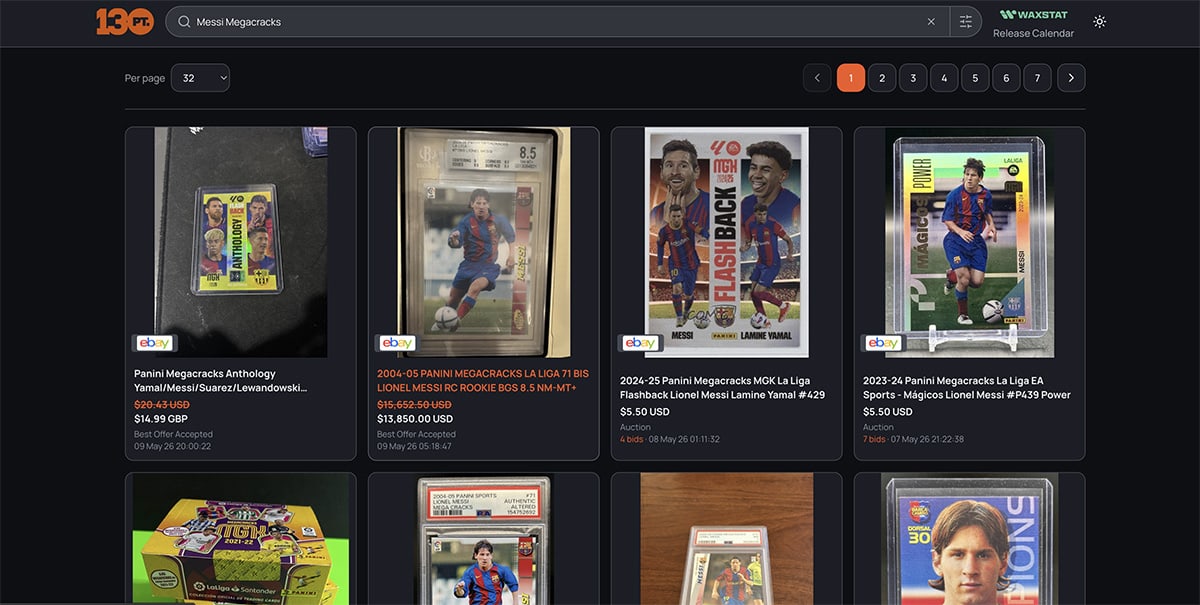
130point is one of the most popular tools among sports card collectors because it reveals eBay sold listings, accepted Best Offer prices and historical sales comps all in one place.
This matters because many expensive cards don’t actually sell for the publicly displayed eBay sold price. A seller might accept a lower offer privately, meaning the true value of the sale is hidden from most buyers and sellers.
130point helps cut through that and gives you a much clearer idea of what the card most likely actually sold for.
For example, an eBay listing might show as sold for £2,000, but the actual accepted offer could have been closer to £1,550. Without 130point, you’d potentially be valuing your card using inflated data and getting a completely inaccurate view of the market.
This becomes especially important with higher-end cards where negotiations happen regularly behind the scenes. Rookie cards, rare parallels, autographs, vintage cards and high grade slabs are all areas where 130point becomes incredibly useful.
Go to the sales search page and search the exact card name. For example: “2018 Prizm Luka Doncic Silver PSA 10”.
Once the results load up, compare the recent sales while making sure you’re looking at cards that actually match yours properly. The grade, the parallel, the serial numbering and even the timing of the sale all matter massively.
For example a PSA 10 Gold /10 that sold during an NBA playoff run is naturally going to command a very different premium compared to the exact same card sold during the off-season.
One of the biggest mistakes newer collectors make is comparing completely different versions of the same card. A base rookie card is not the same as a Silver. A Silver is not the same as a Gold. A raw card is not the same as a PSA 10.
Even though they might look almost identical to somebody newer to the hobby, rarity and scarcity are some of the biggest drivers behind sports card prices.
Just like with eBay completed sales, make sure you’re focusing on recent data, ideally within the last 7-30 days. Sports card prices can move incredibly quickly depending on injuries, trades, playoff performances or even just hype around a player. Using sales data from 6-12 months ago without context can give you a completely false idea of what the card is actually worth today.
PriceCharting is one of the quickest ways to get a general understanding of how to check trading card value.
It pulls together recent sales data and organises it into simple averages, making it incredibly useful for checking raw card prices, PSA graded values, historical charts and overall market trends.
Instead of manually searching through dozens of sold listings, PriceCharting gives you a fast snapshot of where the market currently sits.
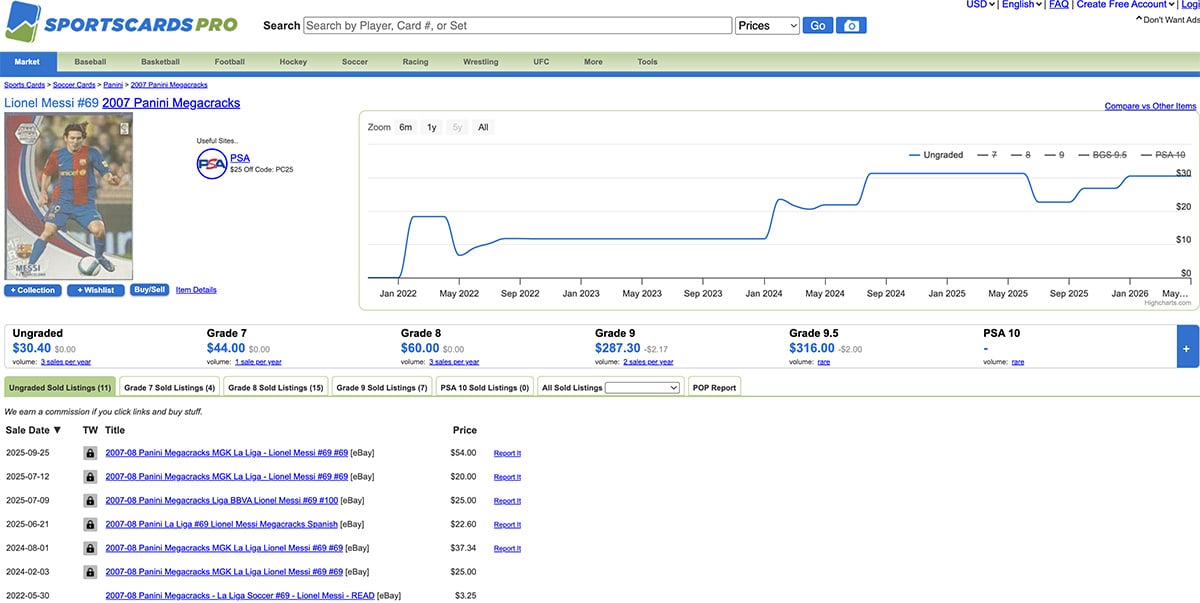
One of the biggest strengths of PriceCharting is how easy it is to compare different grades of the same card all in one place.
You can instantly see the difference between:
This becomes especially useful when you’re trying to decide whether a card is worth grading or if buying an already graded copy makes more sense financially.
For example, if a raw card sells for £80 but a PSA 10 consistently sells for £800, it gives you a much clearer understanding of the potential premium attached to condition and grading.
PriceCharting is also useful for spotting longer-term market trends.
If a player’s cards have steadily climbed over the last 6-12 months, you’ll usually see that reflected in the chart history. The same applies in reverse if the market has cooled off.
Especially if you’re checking multiple cards quickly.
As useful as PriceCharting is, you should always verify prices using recent sold listings on eBay and 130point.
Sports card markets move incredibly quickly and averages can sometimes lag behind what’s actually happening in real time.
A player coming off a huge playoff performance or major injury can completely change the market almost overnight.
PriceCharting works best as a quick reference tool, but eBay completed sales and 130point will always give you the most accurate picture of what buyers are currently willing to pay.
Ready to make the most of your hobby? Sign up today to unlock full access to all our tools and join a growing community of collectors.
Sign Up for Free